
If you’re comparing Stocks & Shares ISAs in the UK, you’ll quickly run into two common investment types: ETFs and OEICs.
Both let you invest in a diversified portfolio (like the S&P 500 or global equities), but they behave very differently — and those differences can impact your costs, flexibility, and returns.
This guide explains exactly what you need to know.
If you’re choosing a platform, compare the cheapest Stocks & Shares ISA in the UK or if you’re new to investing, our beginner ISA guide explains which platforms are easiest to start with.
Jump to:
Quick summary · ETFs · OEICs · Differences · Costs · Verdict · FAQs
Quick Verdict:
- Cheapest option: ETFs (especially on 0% fee platforms)
- Simplest option: OEICs
- Best for most UK investors: ETFs on a low-cost platform
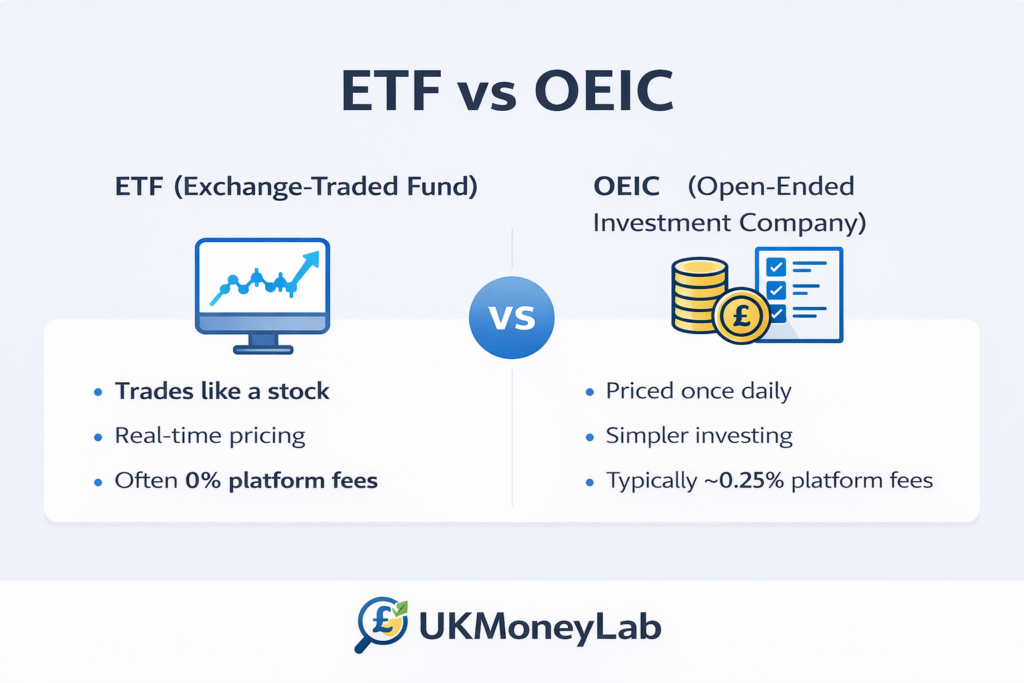
Quick Summary: ETF vs OEIC
| ETFs (Cheaper) | OEICs (Simpler) | |
|---|---|---|
| Type | ETF (Exchange-Traded Fund) | OEIC (Open-Ended Investment Company) |
| How you buy | Traded on stock exchange (like shares) | Bought directly from fund provider |
| Pricing | Real-time market price | Priced once per day |
| Minimum investment | Often price of 1 share | Can invest small amounts (£25–£100+) |
| Dealing fees | Usually applies | Often free (platform dependent) |
| Platform fees | Often cheaper (or capped) | Percentage-based (can get expensive) |
| Flexibility | High (buy/sell anytime market open) | Lower (once daily dealing) |
In short:
- ETFs = cheaper + more flexible
- OEICs = simpler + beginner-friendly
What is an ETF?
An ETF (Exchange-Traded Fund) is a fund that trades on the stock market, just like a share.
Key characteristics:
- Tracks an index (e.g. FTSE 100, S&P 500)
- Trades throughout the day
- Prices change in real time
- Bought via a broker/platform (e.g. Trading 212, InvestEngine)
Example:
- Vanguard S&P 500 UCITS ETF (VUSA / VUAG)
Think of ETFs as “shares of a fund” you can trade anytime.
What is an OEIC?
An OEIC (Open-Ended Investment Company) is a traditional UK fund.
Key characteristics:
- Bought directly from fund providers (e.g. Vanguard, Fidelity)
- Priced once per day (forward pricing)
- No live trading
- Often used for:
- index funds
- actively managed funds
Example:
- Vanguard FTSE Global All Cap Index Fund
Think of OEICs as “set-and-forget funds” priced once daily.
Key Differences That Actually Matter
1. Costs (This is the BIG one)
This is where most investors should pay attention.
- ETFs
- Often 0% platform fee (e.g. InvestEngine, Trading 212)
- Small dealing fees (or none on some platforms)
- Lower total cost for large portfolios
- ETFs may include FX fees (e.g. 0.15%–0.45%) when buying US-listed assets
- OEICs
- Typically 0.25% platform fee
- No dealing fees (on most platforms)
- Can become expensive as portfolio grows
- OEICs are usually GBP-based, avoiding FX costs
Example:
- £100,000 in OEICs at 0.25% = £250/year
- Same in ETFs on a free platform = £0/year platform fee
This is why ETF platforms often appear cheapest in ISA comparisons — but always check FX fees and whether you’ll need OEIC funds later.
2. How You Trade
- ETF
- Buy/sell instantly during market hours
- Can set limit orders
- Prices fluctuate throughout the day
- OEIC
- Orders executed once per day
- Price unknown at time of order
For long-term investors, this difference is usually not critical.
3. Ease of Use
- OEICs
- Easier for beginners
- Simple monthly investing
- No need to think about share prices
- ETFs
- Slightly more complex
- Need to buy whole shares (on some platforms)
OEICs win for simplicity.
4. Investment Options
- ETFs
- Strong for:
- index investing
- global exposure
- low-cost strategies
- Limited access to some niche/active funds
- Strong for:
- OEICs
- Wider range:
- active funds
- niche strategies
- multi-asset funds
- Wider range:
If you want active management, OEICs often dominate.
5. Income & Accumulation
Both ETFs and OEICs offer:
- Income versions (pay dividends)
- Accumulation versions (reinvest automatically)
No major difference here — just choose based on your goal.
Which is Cheaper in the UK?
This depends more on the platform than the fund type — but:
- ETFs are usually cheapest on:
- “zero-fee” platforms
- flat-fee brokers
- OEICs can be competitive:
- at lower balances (£10k–£20k)
- with regular investing
This is why ISA platform comparisons often show ETFs as the cheapest option, while traditional fund platforms remain competitive for OEICs:
- AJ Bell / Fidelity → competitive for funds (OEICs)
- Trading 212 / InvestEngine → cheapest for ETFs
Compare the cheapest Stocks & Shares ISA platforms in the UK
When Should You Choose ETFs?
ETFs are usually better if you:
✔ Want the lowest possible fees
✔ Have a larger portfolio (£20k+)
✔ Are happy using a trading-style platform
✔ Prefer passive investing (e.g. S&P 500)
When Should You Choose OEICs?
OEICs may be better if you:
✔ Want simplicity
✔ Invest monthly with small amounts
✔ Prefer set-and-forget investing
✔ Want access to active funds
ETF vs OEIC: Who Each Is Best For
| You are… | Best option |
|---|---|
| Cost-focused investor | ETFs |
| Beginner | OEICs |
| Investing £20k+ | ETFs |
| Monthly investing small amounts | OEICs |
ETF vs OEIC: Final Verdict
- Most cost-efficient: ETFs
- Most beginner-friendly: OEICs
- Best overall (for many UK investors): ETFs on a low-cost platform
But the best choice depends on:
- your platform
- your portfolio size
- how hands-on you want to be
How This Links to ISA Platform Costs
When comparing Stocks & Shares ISA platforms:
- ETF platforms often look cheapest because:
- 0% platform fees
- no custody charges
- But:
- FX fees may apply
- some don’t support OEICs
Always match the platform to the investment type you plan to use.
For a full comparison, see our guide to the cheapest Stocks & Shares ISA platforms in the UK.
If you’re looking for the best all-round option, see our guide to the best Stocks & Shares ISAs in the UK.
FAQs
Are ETFs safer than OEICs?
No — both can track the same underlying assets. Risk depends on what you invest in, not the structure.
Do ETFs outperform OEICs?
Not inherently. If both track the same index, performance should be nearly identical (minus fees).
Can I hold both in an ISA?
Yes — most UK platforms allow a mix of ETFs and OEICs (except some ETF-only providers).
Why are ETFs cheaper than OEICs?
Because of platform fee structures, not necessarily the fund itself.
Final Thought
If you’re building a long-term portfolio:
Costs matter more than structure.
For many UK investors today, that means:
- ETFs + low-cost platform = best value
But if you value simplicity, OEICs are still a solid choice.
Ready to invest? Compare the cheapest Stocks & Shares ISA platforms in the UK