
This guide compares the cheapest Stocks & Shares ISA UK platforms based on total annual costs at £10k, £50k and £100k portfolio sizes. In practice, the “cheapest” platform isn’t always obvious — it depends heavily on what you invest in, how often you invest, and how large your portfolio becomes over time. When comparing the cheapest Stocks & Shares ISA UK platforms, fees are one of the most important factors to consider.
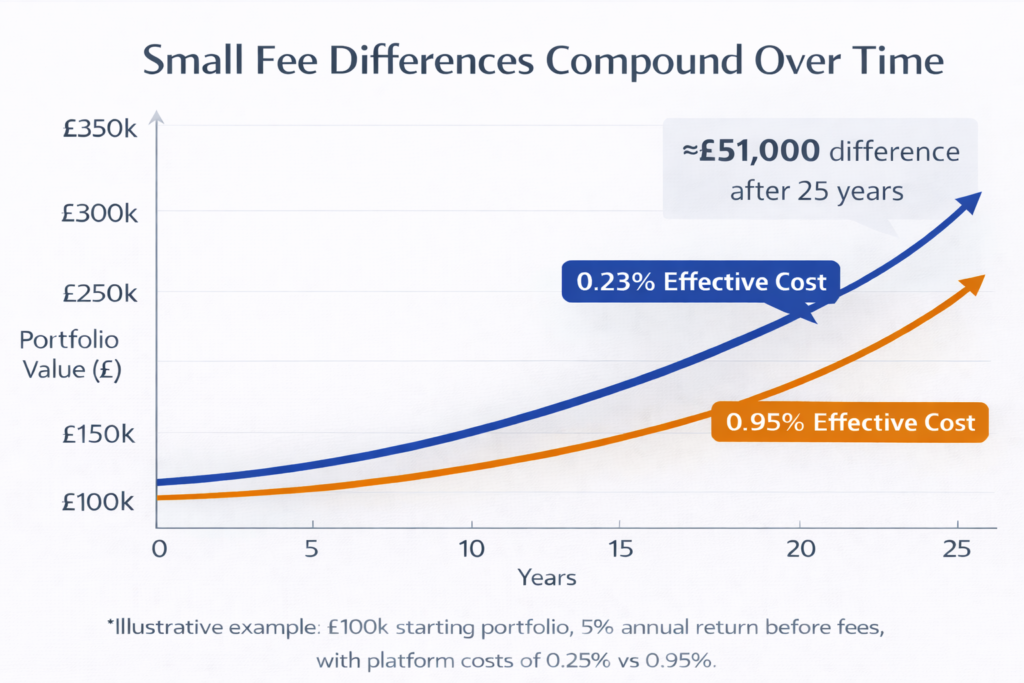
Investment fees may look small — 0.25%, 0.35%, even 0.50% — but over decades they can significantly reduce long-term portfolio growth. This is one of the most commonly overlooked aspects of investing — especially for beginners who focus on performance but underestimate the impact of fees.
This guide compares the cheapest Stocks & Shares ISA UK platforms based on real annual costs.
Disclosure: Some links in this article may be affiliate links. This means we may receive a small commission if you open an account through these links, at no additional cost to you. This helps support the site and keeps our guides free to read.
Summary: Based on our modelling, a few clear patterns emerge. Several platforms now offer very low or near-zero cost investing for ETFs, including Trading 212, InvestEngine, IG, Freetrade and Scottish Widows.
For traditional funds (OEICs), newer low-cost options such as Freetrade and Scottish Widows appear among the cheapest in this comparison, particularly when assuming regular investing. However, established platforms such as AJ Bell and Interactive Investor remain competitive depending on portfolio size and fee structure.
Quick Verdict: Cheapest Stocks & Shares ISA UK Platforms
If you’re looking for the lowest possible fees, a small number of platforms consistently come out on top — but the “right” choice still depends on how you invest.
Based on the fee modelling in this guide:
• Cheapest ETF platforms: Trading 212, InvestEngine, IG, Freetrade and Scottish Widows (very low or zero platform costs depending on assumptions)
• Cheapest fund platform: Freetrade and Scottish Widows appear among the lowest-cost options in this model, with AJ Bell competitive at smaller portfolio sizes
• Flat-fee platforms become competitive above ~£50k: Interactive Investor
• Best low-cost option for Vanguard funds: Vanguard Investor
In practice, the “cheapest” platform depends on how you invest — particularly whether you use regular investing, which can remove dealing fees on some platforms. Most investors choose between just a handful of platforms based on simplicity, cost and flexibility.
It also depends on:
- whether you invest in ETFs or mutual funds (OEICs)
- the size of your portfolio
- how frequently you trade.
The full comparison tables below show how costs change across different portfolio sizes.
Several of the cheapest Stocks & Shares ISA UK platforms now offer very low or near-zero cost investing depending on how you invest.
All calculations are based on publicly available fee schedules and standardised assumptions to ensure a fair comparison.
Jump to:
- Cheapest ISA platforms for funds
- Cheapest ISA platforms for ETFs
- Which platform is cheapest overall?
Which Is the Cheapest Stocks & Shares ISA UK Platform?
The cheapest Stocks & Shares ISA UK platform depends largely on how you invest.
For ETF investors, several platforms now offer very low or near-zero cost investing, including Trading 212, InvestEngine, IG, Freetrade and Scottish Widows. These platforms can minimise platform and dealing fees, particularly when investing regularly.
For fund investors (OEICs), newer low-cost options such as Freetrade and Scottish Widows appear among the cheapest in this comparison when assuming regular investing. However, established platforms such as AJ Bell remain competitive at smaller portfolio sizes, while flat-fee providers such as Interactive Investor can become more cost-effective as portfolios grow.
The tables below compare the total annual cost of investing across the UK’s major ISA providers at £10k, £50k and £100k portfolio sizes.
How this comparison works
We model:
- Platform fees (percentage, flat or tiered)
- Ongoing fund costs (OCF)
- Regular investing dealing charges (12 trades per year)
We compare two scenarios:
Funds (OEICs) – based on a 0.23% OCF (Vanguard FTSE Global All Cap)
ETFs – based on a 0.22% OCF (Vanguard FTSE All-World ETF)
We’ve kept the assumptions simple so that comparisons are consistent, but actual costs can vary slightly depending on how you invest in practice.
All figures shown are annual costs.
Foreign exchange charges are excluded from the base case unless noted.
Where platforms offer free regular investing, this has been assumed in the model to ensure a consistent comparison.
Assumptions used
- 12 regular investments per year
- Portfolio sizes: £10,000 / £50,000 / £100,000
- Funds OCF assumed: 0.23%
- ETF OCF assumed: 0.22%
- FX costs excluded unless stated
- Fees taken from published provider fee schedules
Annual Cost Comparison – OEIC (Fund) Investing
The table below compares the annual cost of investing in traditional funds (OEICs) across major UK Stocks & Shares ISA platforms.
| Platform | £10,000 | £50,000 | £100,000 | Notes |
|---|---|---|---|---|
| AJ Bell | £48 | £240 | £480 | 0.25% platform fee. £1.50 regular fund trades included in model. |
| Fidelity | £58 | £290 | £580 | 0.35% platform fee. £90 annual minimum under £25k. |
| Hargreaves Lansdown | £58 | £290 | £580 | 0.45% platform fee (new fee structure from Mar 2026). Fund dealing free via regular investing. |
| IG | N/A | N/A | N/A | ETF-only provider. No traditional OEIC funds. |
| Interactive Investor | £95 | £187 | £302 | Flat fee (£5.99/month). Regular fund investing free. |
| InvestEngine | N/A | N/A | N/A | ETF-only platform. No traditional OEIC funds. |
| Trading 212 | N/A | N/A | N/A | ETF-only platform. No traditional OEIC funds. |
| Vanguard | £71 | £190 | £380 | 0.15% platform fee (£4/month under £32k; £375 annual cap). |
| Freetrade | £23 Cheapest | £115 Cheapest | £230 Cheapest | Supports funds, ETFs and shares. No platform or dealing fees assumed. ISA may require subscription. FX not included. |
| Scottish Widows | £23 Cheapest | £115 Cheapest | £302 Cheapest | Supports funds, ETFs and shares. No platform fee. £5 trades, but regular investing assumed (free). FX and dividend charges not included. |
IG, InvestEngine and Trading 212 are ETF-only platforms and do not offer traditional OEIC funds. Costs shown reflect modelling assumptions for comparison purposes only.
Fee data last updated: March 2026.
Fees sourced from publicly available platform schedules (for example, Vanguard’s published fee schedule).
Takeaway: At smaller portfolio sizes, several platforms now appear among the lowest-cost options, including Freetrade and Scottish Widows when assuming regular investing. As portfolio sizes increase, fee structures begin to matter more, with flat-fee platforms becoming more competitive at larger balances.
In reality, most investors won’t notice small fee differences at lower portfolio sizes — but as your investments grow, these differences become much more meaningful.
Key Observations – OEIC Investors
At smaller portfolio sizes (£10,000), a wider range of platforms now appear cost-competitive.
In this comparison, low-cost providers such as Freetrade and Scottish Widows sit alongside more established platforms, largely due to the assumption of no platform fees and free regular investing.
As portfolios grow, platform fee structures start to matter more.
At £50,000 and £100,000, percentage-based platforms continue to scale with portfolio size, while flat-fee providers such as Interactive Investor become relatively more competitive.
The lowest-cost option depends heavily on how you invest in practice.
Platforms that appear cheapest in this model often rely on specific assumptions — particularly regular investing — which may not apply to all investors.
ETF-only platforms are excluded from this comparison.
Platforms such as Trading 212, InvestEngine and IG do not offer traditional OEIC funds and are therefore only relevant for ETF-based investing.
For investors using mutual funds, the choice of platform is not just about cost.
Ease of use, fund availability and long-term flexibility can be just as important as minimising fees.
ETF vs OEIC: What’s the Difference?
Traditional investment funds in the UK are typically structured as OEICs (Open-Ended Investment Companies), while ETFs (Exchange-Traded Funds) trade on stock exchanges like individual shares.
Both can track the same index, but they differ in how they are bought, sold and priced:
- OEICs are priced once per day and can be purchased directly from fund platforms.
- ETFs trade throughout the day on the stock market and may involve dealing charges.
ETFs often have slightly lower ongoing costs, but the best option depends on how frequently you invest and the size of your portfolio.
For a full breakdown, see our guide: ETF vs OEIC – What’s the Difference?
In recent years, many platforms have introduced fractional ETF investing, making ETFs easier to invest in regularly.
In practice, many beginners start with funds for simplicity, before moving to ETFs as they become more comfortable investing.
Stocks & Shares ISAs are regulated under rules set by HMRC, including annual contribution limits and tax treatment (see official HMRC guidance).
Annual Cost Comparison – ETF Investing
Exchange-traded funds (ETFs) are increasingly popular due to their typically lower ongoing charges and the availability of low-cost ETF-focused platforms. The table below compares the total annual cost of investing in ETFs across the same three portfolio sizes, assuming regular monthly investing.
For many investors, ETFs have become a popular option due to their lower costs and the growing number of platforms offering low or zero-fee investing.
Unlike the OEIC comparison above, the table below compares the annual cost of investing in ETFs using regular monthly investing.
| Platform | £10,000 | £50,000 | £100,000 | Notes |
|---|---|---|---|---|
| AJ Bell | £89 | £194 | £304 | 0.25% custody fee (shares account). £3.50 regular ETF trades. |
| Fidelity | £75 | £218 | £328 | £90 annual minimum under £25k. £1.50 regular ETF trades. |
| Hargreaves Lansdown | £57 | £260 | £370 | 0.45% custody fee capped at £150/year for ETFs. |
| IG | £22 Cheapest | £110 Cheapest | £220 Cheapest | ETF-only provider. No platform fee. |
| Interactive Investor | £142 | £230 | £340 | Flat fee (£5.99/month). £3.99 per ETF trade. |
| InvestEngine | £22 Cheapest | £110 Cheapest | £220 Cheapest | ETF-only. No platform or dealing fees (managed option not modelled). |
| Trading 212 | £22 Cheapest | £110 Cheapest | £220 Cheapest | ETF-only. No platform fee (FX fees not modelled). |
| Vanguard | £70 | £185 | £370 | 0.15% platform fee (£4/month under £32k; £375 cap). No ETF dealing charge. |
| Freetrade | £22 Cheapest | £110 Cheapest | £220 Cheapest | No platform or dealing fees assumed. FX (~0.99%) not included. ISA may require subscription. |
| Scottish Widows | £22 Cheapest | £110 Cheapest | £220 Cheapest | No platform fee. £5 trades (regular investing free). FX and dividend charges not included. |
Fee data last updated: March 2026.
Fees sourced from publicly available platform schedules (for example, Vanguard’s published fee schedule).
Takeaway: Several platforms now offer very low or near-zero cost ETF investing, including Trading 212, InvestEngine, IG, Freetrade and Scottish Widows.
However, the lowest-cost option in practice depends on how you invest — particularly whether you use regular investing, as well as factors such as FX charges and platform features.
Key Observations – ETF Investors
A growing number of platforms now offer very low-cost or effectively zero-cost ETF investing.
Platforms such as Trading 212, InvestEngine, IG, Freetrade and Scottish Widows appear among the lowest-cost options in this comparison, largely because platform fees and regular investing costs can be minimal or removed entirely.
In practice, this means that for many investors, the underlying ETF cost (OCF) becomes the main ongoing cost rather than platform fees.
Traditional platforms remain competitive depending on how you invest.
Platforms such as Vanguard, AJ Bell and Fidelity charge platform fees, but these can still represent good value depending on portfolio size, investment choice and whether additional features are important.
Dealing costs still matter when investing regularly.
Platforms that charge for ETF trades can become more expensive when investing monthly. Even relatively small dealing fees can add up over time.
Low-cost platforms may come with trade-offs.
While some platforms offer extremely low costs, they may have limitations in areas such as investment range, research tools or overall platform experience.
For investors focused purely on minimising fees, low-cost ETF platforms can significantly reduce long-term costs — but the best choice will depend on your overall investment approach.
Which ISA Platform Is Cheapest?
There isn’t a single platform that is cheapest in every scenario – which is why comparing based on your own portfolio size and investment type is important.
While platform fees vary depending on portfolio size and investment type, the comparison above highlights a few clear patterns.
Cheapest for Smaller Portfolios (£10,000)
At smaller portfolio sizes, a wider range of platforms now appear cost-competitive. In this comparison, low-cost providers such as Freetrade and Scottish Widows sit alongside ETF-focused platforms such as Trading 212, InvestEngine and IG, largely due to the assumption of no platform fees and free regular investing.
Cheapest for Medium Portfolios (£50,000)
At mid-sized portfolios, fee structures begin to matter more. Platforms with percentage-based fees start to look more expensive as portfolio values increase, while flat-fee providers and low-cost ETF platforms can offer meaningful cost advantages depending on how you invest.
Cheapest for Larger Portfolios (£100,000)
At higher portfolio values, flat-fee platforms and fee caps become increasingly important. Platforms such as Interactive Investor can become more competitive, while low-cost providers may remain attractive if platform and dealing fees are kept to a minimum.
In practice, the cheapest stocks & shares ISA UK platform depends on more than headline fees. Factors such as regular investing, FX charges, investment range and platform usability can all influence the overall cost and suitability of an ISA provider.
The Key Takeaway
The cheapest ISA platform depends on three main factors:
- The size of your portfolio
- Whether you invest in funds (OEICs) or ETFs
- How frequently you trade
For investors focused on minimising fees, a number of platforms now offer very low or near-zero cost investing, particularly for ETFs. However, the lowest-cost option will depend on how you invest, including whether you use regular investing and the types of investments you choose.
For investors using mutual funds (OEICs) or seeking broader investment features, more traditional platforms may still represent good value depending on portfolio size and fee structure.
Best Low Cost Stocks & Shares ISA for Beginners
For beginners, the cheapest Stocks & Shares ISA is not always the best choice.
While low fees are important, new investors should also consider:
• Ease of use
• Investment choice
• Educational resources
• Regular investing options
Platforms such as Trading 212, InvestEngine, Vanguard and Freetrade are often popular with beginners due to their combination of low costs and simple investing experiences.
Investors who prefer traditional funds may also wish to consider platforms that support OEICs and regular investing.
If you’re completely new to investing, see our Beginner ISA Guide.
Who Each Platform Suits
While cost is important, most investors don’t choose a platform based on fees alone. Ease of use, investment choice and long-term flexibility can matter just as much.
Each platform has a slightly different fee structure and investment offering. The best choice will depend on your portfolio size, investment style, and whether you prefer funds or ETFs.
If you’re just getting started, you may prefer a simpler platform – see our beginner ISA guide.
Vanguard Investor
Best for: Simple long-term investing in Vanguard funds and ETFs.
Vanguard offers a straightforward platform focused on its own range of low-cost funds and ETFs. The platform fee is relatively low and capped annually, making it a popular option for long-term passive investors who are comfortable investing primarily in Vanguard products.
Hargreaves Lansdown
Best for: Investors who value research tools and a broad investment range.
Hargreaves Lansdown is one of the UK’s most established investment platforms and offers access to a wide selection of funds, shares and ETFs. While its percentage-based platform fee can become more expensive for larger portfolios, the platform provides strong research tools and a well-developed mobile and web experience.
AJ Bell
Best for: Investors seeking a balance between platform features and cost.
AJ Bell offers a competitive fee structure and access to a broad range of investments, including funds, shares and ETFs. Its platform fees sit between lower-cost ETF providers and more premium platforms, making it a balanced option for many investors.
Fidelity
Best for: Long-term investors who prefer funds and regular investing.
Fidelity’s platform supports a wide range of mutual funds and ETFs, with no dealing charge for fund purchases. Its percentage-based fee structure can be competitive at smaller portfolio sizes, particularly for investors who prefer regular contributions.
Interactive Investor
Best for: Larger portfolios that benefit from a flat monthly fee.
Interactive Investor charges a flat subscription fee rather than a percentage of assets. This structure becomes increasingly attractive for larger portfolios where percentage-based fees would otherwise scale with portfolio size.
Trading 212
Best for: Low-cost ETF investors who want a simple mobile-first platform.
Trading 212 offers commission-free investing in shares and ETFs with no platform fee. However, it does not support traditional mutual funds (OEICs), meaning it is primarily suited to investors focusing on ETFs rather than traditional mutual funds.
InvestEngine
Best for: Investors building ETF portfolios with minimal platform costs.
InvestEngine focuses on ETF investing and does not charge a platform fee for its DIY portfolios. Like Trading 212, it does not currently support traditional OEIC funds, so it is best suited to investors comfortable using ETFs exclusively.
IG
Best for: Investors who want ETF investing within a more traditional trading platform.
IG offers a stocks and shares ISA with access to shares and ETFs. While it is primarily known as a trading platform, its ISA offering can be competitive for ETF investors, although it does not currently support traditional OEIC mutual funds. Its ISA offering can be competitive on cost, although it is generally more suited to investors comfortable with trading-style platforms.
Freetrade
Best for: Simple, low-cost investing across ETFs, shares and funds.
Freetrade offers commission-free investing with a clean, app-based experience. It supports ETFs, shares and a growing range of mutual funds, making it more flexible than some ETF-only platforms. Costs can be very low depending on how you invest, although ISA access and features may depend on the plan used.
Read our full Freetrade ISA Review.
Scottish Widows
Best for: Low-cost investing with regular contributions.
Scottish Widows offers a simple fee structure with no platform fee and the option for free regular investing. It supports funds, ETFs and shares, making it a flexible option in this comparison. While it may not offer the same user experience or tools as some modern platforms, it can be a cost-effective choice depending on how you invest.
Other Factors to Consider When Choosing an ISA Platform
While platform fees can have a meaningful impact on long-term investment returns, they are not the only factor worth considering when selecting a Stocks & Shares ISA provider.
Investment Range
Some platforms specialise in ETFs, while others offer a wider range of investments including mutual funds, individual shares, investment trusts and bonds. Investors who prefer traditional mutual funds may need to choose a platform that supports OEICs, whereas ETF-focused investors may have more options.
Platform Experience
The usability of a platform’s website and mobile app can make a significant difference to the investing experience. Some platforms offer advanced research tools, portfolio analytics and educational resources, while others focus on a simpler, lower-cost interface.
Additional Accounts
Many investors eventually open additional accounts alongside their ISA. Some providers offer a broader range of products such as Self-Invested Personal Pensions (SIPPs), Junior ISAs or general investment accounts, which can make it easier to manage multiple investments within the same platform.
Customer Support
Customer service can also be an important consideration, particularly for new investors. Established platforms often provide extensive help centres and telephone support, while lower-cost platforms may rely more heavily on digital support channels.
Final Thoughts
Platform fees may appear small, but over time they can make a meaningful difference – particularly as your portfolio grows.
For most investors, the goal isn’t to find the absolute cheapest stocks & shares ISA UK platform, but one that keeps costs low while still being easy to use and suitable for long-term investing.
This comparison shows that the cheapest stocks & shares ISA UK platform depends largely on how you invest — whether you prefer ETFs or mutual funds, how frequently you invest, and the size of your portfolio.
A growing number of platforms now offer very low or near-zero cost investing, particularly for ETFs and regular contributions. However, traditional investment platforms may still provide a wider investment range and additional features that some investors value.
Ultimately, the best ISA platform is the one that balances cost, investment choice and usability in a way that supports your long-term investment strategy.
If you’re looking beyond cost alone, see our guide to the best Stocks & Shares ISAs in the UK.
If you’re unsure whether ETFs or funds are right for you, see our ETF vs OEIC guide.
FAQs
Which ISA platform is cheapest for ETFs?
Which ISA platform is cheapest for ETFs?
Several platforms now offer very low or near-zero cost ETF investing, including Trading 212, InvestEngine, IG, Freetrade and Scottish Widows. The cheapest option depends on how you invest, particularly whether you use regular investing and the impact of FX fees.
Are ETFs cheaper than funds in an ISA?
Often yes. ETFs typically have slightly lower ongoing charges and can be held on platforms with no platform fee.
Does portfolio size affect ISA platform costs?
Yes. Percentage-based platform fees increase with portfolio size, while flat-fee platforms become more competitive at larger balances.
What is the cheapest Stocks & Shares ISA UK platform?
What is the cheapest Stocks and Shares ISA in the UK?
Choosing the cheapest Stocks & Shares ISA UK depends on your investment approach.
For ETFs, a number of platforms — including Trading 212, InvestEngine, IG, Freetrade and Scottish Widows — can offer very low costs depending on usage.
For traditional funds (OEICs), platforms such as Freetrade and Scottish Widows appear among the cheapest in this comparison when assuming regular investing, while providers like AJ Bell and Interactive Investor may be competitive depending on portfolio size.
Do platform fees matter for long-term investing?
Yes. Even small differences in platform fees can significantly affect long-term investment returns.
For example, a difference of around 0.7% per year in fees could reduce a £100,000 portfolio by over £50,000 after 25 years.
Is there a completely free ISA in the UK?
Some platforms offer zero platform fees, but other costs such as FX charges or fund fees may still apply.
What is the best low cost Stocks & Shares ISA for beginners?
For beginners, the best low cost Stocks & Shares ISA is often one that balances low fees with ease of use.
Platforms such as Trading 212, InvestEngine, Vanguard and Freetrade are popular with beginners because they offer straightforward investing experiences alongside competitive costs.
Should beginners choose ETFs or funds?
Both ETFs and funds can be suitable for beginners.
Funds (OEICs) are often considered simpler because they can be purchased directly through investment platforms, while ETFs may offer slightly lower costs and greater flexibility.