
Vanguard vs Trading 212 ISA is a common comparison for UK investors choosing a Stocks and Shares ISA, but the two platforms are designed for quite different types of investor.
The decision usually comes down to simplicity versus flexibility. Vanguard provides a straightforward way to invest in its own funds and ETFs, while Trading 212 offers a wider, app-based investment choice that includes ETFs and individual shares.
For investors comparing Trading 212 vs Vanguard, the main differences include fees, investment choice, ease of use and how much control you want over your portfolio.
This guide compares the Vanguard and Trading 212 Stocks and Shares ISAs, including their costs, advantages, disadvantages and suitability for beginners.
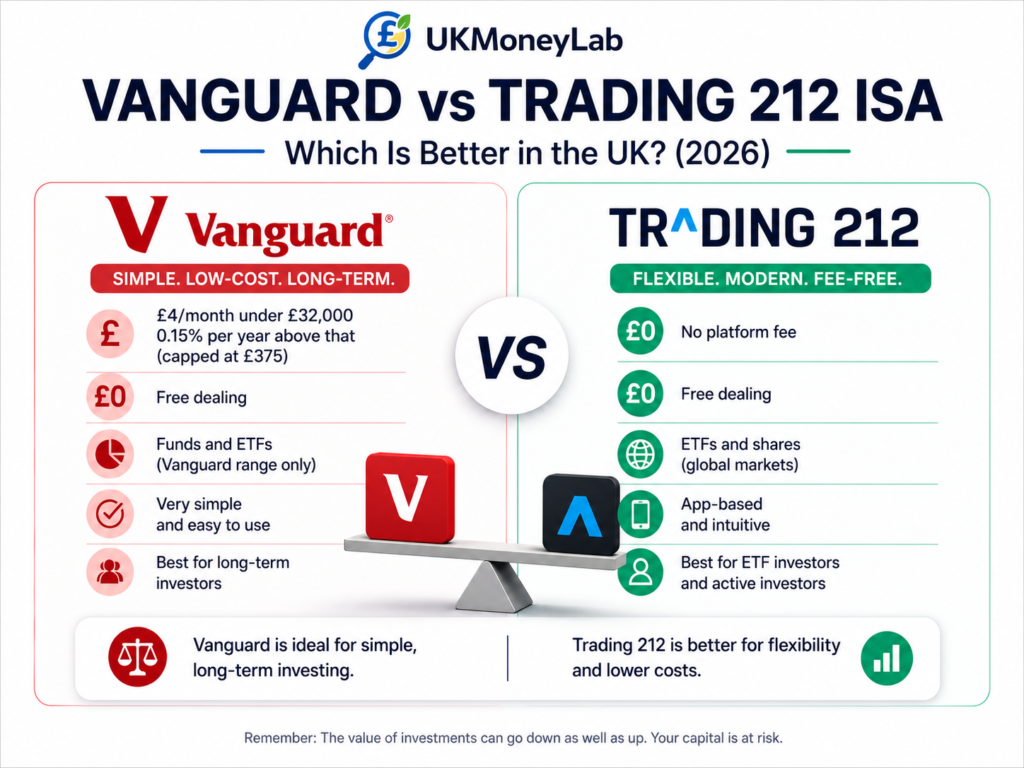
Quick answer: Vanguard vs Trading 212 ISA
Trading 212 is usually the cheaper option for ETF investors because it has no custody fee or trading commission, although a 0.15% FX fee may apply where currency conversion is required.
Vanguard may suit investors who want a simpler, more straightforward long-term investing experience using Vanguard’s own funds and ETFs.
- Choose Vanguard if you want simplicity.
- Choose Trading 212 if you want lower platform costs, more investment choice and more control.
For many investors, the decision comes down to simplicity vs flexibility.
Vanguard vs Trading 212 ISA comparison table
| Feature | Vanguard ISA | Trading 212 ISA |
|---|---|---|
| Platform/account fee | £4/month under £32,000, then 0.15% per year capped at £375 | £0 custody fee |
| Trading commission | No dealing charge for mutual funds or bulk ETF dealing; optional live ETF trades cost £7.50 | Free |
| Currency and market costs | ETF bid-offer spreads may apply; optional live ETF dealing costs £7.50 | 0.15% FX fee where conversion is required; market, tax and exchange charges may also apply |
| Investment choice | Vanguard funds and ETFs only | Wide range of ETFs and shares |
| Mutual funds/OEICs | Yes, Vanguard funds | No traditional OEIC funds |
| Individual shares | No | Yes |
| Best for | Simple long-term investing | Low-cost ETF and share investors |
| Main drawback | Limited to Vanguard investments | More choice means more decisions |
Platform fees checked in July 2026. See Vanguard’s official [account fees] and Trading 212’s official [fees and charges]. Investment charges, spreads and FX costs may also apply.
Trading 212 referral offer
New Trading 212 customers may be eligible to receive fractional shares worth up to £100 when signing up through a valid referral link, subject to Trading 212’s current terms and eligibility rules.
- Sign up for a Trading 212 Invest or Stocks ISA account.
- Verify your identity.
- Fund your account.
- Get fractional shares worth up to £100, subject to Trading 212’s terms.
Referral disclosure: UKMoneyLab may receive a referral reward if you sign up using this link. Rewards, eligibility and offer terms may change. Capital at risk. The value of investments can go down as well as up. This is general information, not personal financial advice.
Vanguard vs Trading 212 ISA fees
Fees are one of the biggest differences between Vanguard and Trading 212.
Vanguard ISA fees
Vanguard’s self-managed ISA charges £4 per month for invested balances below £32,000. For portfolios of £32,000 or more, the fee is 0.15% a year, capped at £375 annually.
Trading 212 ISA fees
Trading 212 does not charge a custody fee or trading commission for its Stocks and Shares ISA. However, a 0.15% FX fee may apply where currency conversion is required.
Which is cheaper? Vanguard vs Trading 212 ISA
On platform and custody fees alone, Trading 212 is cheaper at every portfolio size shown below because it does not charge a custody fee.
Vanguard charges a fixed £48 annual account fee while the total invested balance is below £32,000. At £32,000 and above, it charges 0.15% a year, capped at £375.
This means the platform-fee difference remains £48 a year below £32,000, before increasing with the Vanguard portfolio value until the annual cap is reached.
However, platform fees are not the only cost to consider. Total investment costs can also include fund or ETF ongoing charges, bid-offer spreads, FX fees, taxes and optional dealing charges.
Vanguard may therefore still appeal to investors who specifically want its mutual funds and prefer a narrower, more straightforward investment experience, even though Trading 212 has the lower platform fee.
You can also compare wider platform costs in our Cheapest Stocks and Shares ISA platforms guide.
For a wider breakdown of platform charges, see our guide to ISA fees explained in the UK.
Vanguard vs Trading 212 fees: example costs
| Portfolio size | Vanguard self-managed account fee | Trading 212 custody/platform fee | Cheaper on platform fee? |
|---|---|---|---|
| £5,000 | £48/year | £0 | Trading 212 |
| £10,000 | £48/year | £0 | Trading 212 |
| £25,000 | £48/year | £0 | Trading 212 |
| £32,000 | £48/year | £0 | Trading 212 |
| £50,000 | £75/year | £0 | Trading 212 |
| £100,000 | £150/year | £0 | Trading 212 |
| £250,000 | £375/year | £0 | Trading 212 |
This table only compares platform/account fees. Fund charges, ETF ongoing charges, spreads, FX fees and taxes may still apply depending on what you invest in.
Investment choice: Vanguard vs Trading 212 ISA
Vanguard only offers its own range of funds and ETFs. These are low-cost and well-suited to long-term passive investing, but you won’t have access to other providers.
Trading 212 offers a wider range of investments, including ETFs and individual shares from global markets. However, it does not support traditional mutual funds (OEICs).
Ease of Use: Vanguard vs Trading 212 ISA
Vanguard is designed for simplicity. It’s easy to set up, easy to invest, and requires minimal ongoing management.
Trading 212 offers more control, but with that comes slightly more complexity. The app-based experience is intuitive, but you’ll need to make more decisions about what to invest in.
For many investors, the choice isn’t just about cost — it’s about how involved you want to be in managing your investments.
Which is better for beginners? Vanguard vs Trading 212 ISA
Vanguard may be easier for complete beginners because its investment range is smaller and focused on Vanguard funds and ETFs. This can make it easier to build a straightforward long-term portfolio without facing too many choices.
Trading 212 is also beginner-friendly to use, but its wider selection of ETFs and individual shares means investors need to make more decisions about portfolio construction and risk.
Vanguard ISA pros and cons
Pros
✔ Simple platform for long-term investors
✔ Access to Vanguard’s own low-cost funds and ETFs
✔ Good option for passive investors
✔ Less overwhelming for beginners
Cons
✘ Limited to Vanguard investments
✘ No individual shares
✘ Account fee can be relatively expensive for smaller portfolios
✘ Less flexible than Trading 212
Trading 212 ISA pros and cons
Pros
✔ No custody fee or trading commission
✔ Wide range of ETFs and shares
✔ Flexible app-based investing
✔ Useful for investors who want more control
Cons
✘ More choice can be overwhelming for beginners
✘ No traditional OEIC funds
✘ FX fees may apply on non-GBP investments
✘ Investors need to be more careful about portfolio construction
Who should choose Vanguard?
Vanguard may be the better choice if you:
✔ Want a simple, long-term investing approach
✔ Want access to Vanguard mutual funds as well as ETFs
✔ Don’t want to actively manage your investments
✔ Value ease of use over flexibility
Who should choose Trading 212?
Trading 212 may be better if you:
✔ Want to minimise platform and trading fees
✔ Prefer ETFs or individual shares
✔ Are comfortable using an app-based platform
✔ Want more control over your investments
Final verdict: is Vanguard or Trading 212 better?
Both Vanguard and Trading 212 offer strong ISA options, but they suit different types of investors.
Vanguard may be better suited to investors who want a simple, long-term investing approach with fewer investment choices. Trading 212 may be better suited to investors who want broader investment choice, lower platform fees and more control.
Vanguard vs Trading 212 ISA: For most people, the decision comes down to whether you prefer simplicity or flexibility.
For a broader view, see our guide to the Best Stocks and Shares ISA platforms in the UK.
Stocks and Shares ISAs are governed by UK ISA rules, and ISA managers must be approved by HMRC. See the official ISA guidance for more information. (see official guidance).
This article is for general information only and is not personal financial advice. Investments can go down as well as up, and you may get back less than you invest. ISA and tax rules can change.
Related Stocks & Shares ISA Guides
You may also find these UKMoneyLab guides helpful before choosing a Stocks & Shares ISA.
Trading 212 ISA Review
Commission-free investing, fractional shares and a simple platform
Read Review →Alternative ISA option: IG

IG investing offers
New IG customers can currently access selected investing offers on ISA, GIA or SIPP accounts.
Welcome £300 in free shares
Invest at least £300 with IG and get free shares worth up to £300*.
Claim this offerFree SpaceX shares offer
Invest at least £300 by 31 July to get free SpaceX shares worth up to £1,000**.
View SpaceX offer* Capital at risk. New customers only. Offer valid until 30 days after opening your account on ISA, GIA or SIPP accounts. Minimum share value £40. Cannot be used in conjunction with other offers. Terms & conditions apply.
** Your capital is at risk. New customers only. Min invested £300, reward will be a random allocation of shares. Offer valid until 31/07/2026 on GIA, ISA or SIPP accounts. Cannot be used in conjunction with other offers. T&Cs apply.
UKMoneyLab may receive a commission if you open an account through this link, at no additional cost to you.
FAQs
Is Vanguard or Trading 212 better for beginners?
Vanguard may be easier for beginners because the investment choice is narrower and more focused on long-term funds. Trading 212 can still suit beginners, but it gives you more control and therefore more decisions to make.
Is Trading 212 cheaper than Vanguard?
Trading 212 is usually cheaper on platform fees because it does not charge a custody fee or trading commission. Vanguard charges £4/month for self-managed accounts below £32,000, then 0.15% per year above that, capped at £375.
Is Vanguard or Trading 212 better?
Trading 212 is usually better for investors who want lower platform costs, ETFs, shares and more control. Vanguard is usually better for investors who want a simpler long-term investing experience using Vanguard’s own funds and ETFs.
Can I buy Vanguard ETFs on Trading 212?
Trading 212 offers access to many ETFs, including some Vanguard ETFs. However, it does not offer Vanguard’s traditional mutual funds/OEICs, such as LifeStrategy funds or the FTSE Global All Cap Index Fund.
Does Trading 212 offer a Stocks and Shares ISA?
Yes, Trading 212 offers a Stocks and Shares ISA. It is mainly suited to investors who want to buy ETFs and shares rather than traditional mutual funds.
Does Vanguard offer a Stocks and Shares ISA?
Yes, Vanguard offers a Stocks and Shares ISA in the UK. It is focused on Vanguard’s own funds and ETFs.
Which is better for ETFs, Vanguard or Trading 212?
Trading 212 is usually more flexible for ETF investors because it offers a wider ETF range and has no custody fee. Vanguard may still suit investors who only want Vanguard ETFs and prefer a simpler platform.