
ISA fees explained UK: if you’re investing through a Stocks & Shares ISA, fees can quietly eat into your returns over time.
Platform fees, fund charges and dealing costs may seem small — but over years, they can make a significant difference to your portfolio.
This ISA fees explained UK guide breaks down exactly what you’ll pay and how to keep costs as low as possible.
This guide explains exactly how ISA fees work in the UK, what you’ll pay, and how to keep costs as low as possible — especially as your portfolio grows.
If you’re comparing providers, see our guide to the cheapest Stocks & Shares ISA platforms in the UK.
Jump to:
Platform fees · Fund fees (OCF) · Dealing fees · Example: how fees impact returns · How to minimise ISA fees · FAQs
Quick Answer:
Most UK investors pay three main types of ISA fees:
- Platform fees (charged by the provider)
- Fund fees (ongoing charges within funds or ETFs)
- Dealing fees (when buying or selling investments)
The cheapest option depends on how you invest — particularly whether you use ETFs or funds, how often you invest, and the size of your portfolio.
For most investors, understanding ISA fees explained UK is key to improving long-term returns.
ISA fees can vary significantly between providers.
Platform fees
Platform fees are charged by your ISA provider for holding your investments.
They are typically:
- Percentage-based (e.g. 0.15%–0.45%)
- Flat monthly fees (e.g. £5–£10/month)
- Or zero on some platforms
Percentage fees increase as your portfolio grows, while flat fees can become cheaper over time.
Fund fees (OCF)
Fund fees, also known as the Ongoing Charges Figure (OCF), are built into the fund itself.
Typical costs:
- Index funds: ~0.05%–0.25%
- ETFs: ~0.05%–0.25%
- Active funds: ~0.50%–1.00%+
These fees are deducted automatically and are not shown as a separate charge.
Dealing fees
Dealing fees apply when you buy or sell investments.
Examples:
- £0 on some ETF platforms
- £1.50–£10 per trade on traditional platforms
Many providers offer free regular investing, which can reduce or eliminate dealing fees for monthly contributions.
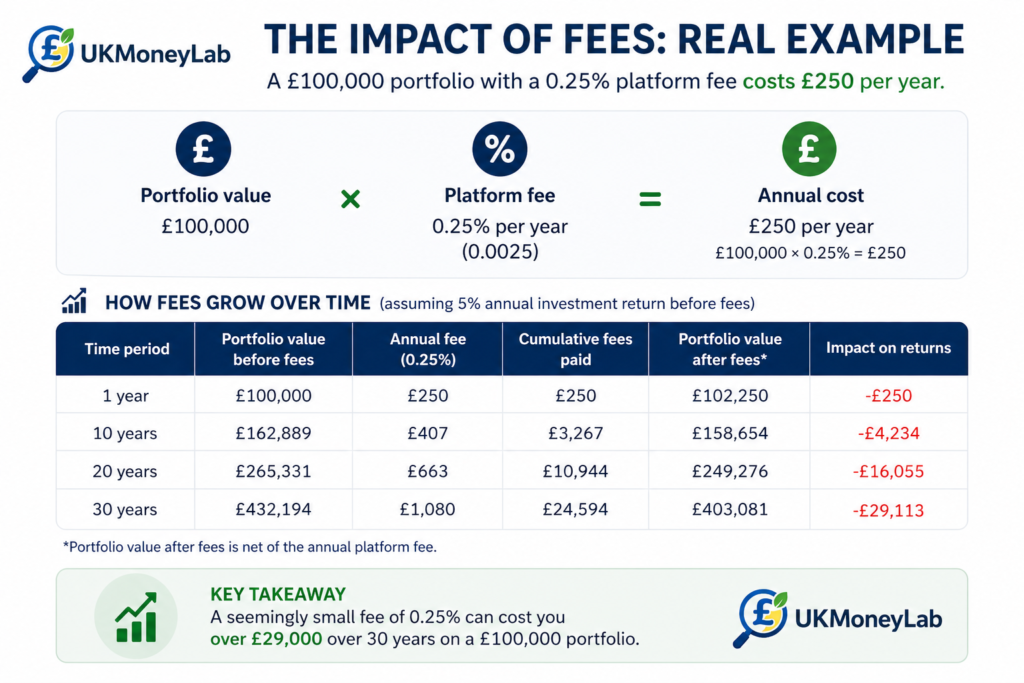
Example: How Fees Impact Returns
For example, a £100,000 portfolio with a 0.25% platform fee costs £250 per year — and this cost increases as your portfolio grows.
Over 25 years, even small differences in fees can significantly reduce total returns — especially when combined with fund charges.
This is why choosing the right ISA platform matters.
Platform Fees vs Fund Fees
Platform fees and fund fees are often confused, but they are separate:
- Platform fees → paid to your ISA provider
- Fund fees → paid within the investment itself
You will usually pay both, so it’s important to consider total cost rather than just one fee.
ETFs vs Funds (brief)
In general:
- ETFs often have slightly lower ongoing costs
- Funds (OEICs) are often simpler to use
However, the platform you choose can have a bigger impact on overall cost than the fund type itself.
For a full comparison, see our ETF vs OEIC guide.
Understanding ISA fees explained UK helps you choose the right platform and avoid unnecessary costs.
How to Minimise ISA Fees
To keep costs low:
- Choose a platform that suits your portfolio size
- Use regular investing where possible
- Consider low-cost index funds or ETFs
- Avoid unnecessary trading
Small savings on fees can have a large impact over time.
In practice, the biggest savings usually come from choosing the right platform for your portfolio size.
Ultimately, ISA fees explained UK comes down to choosing a platform that fits how you invest.
Some platforms also run new customer offers or free share promotions, but these should be treated as a bonus rather than the main reason to choose a provider. You can see our current UK investing platform offers for any available promotions.
To see how fees compare across providers, including real cost examples at £10k, £50k and £100k portfolios, see our guide to the cheapest Stocks & Shares ISA platforms in the UK.
Stocks & Shares ISAs are regulated under HMRC rules (see official guidance).
FAQs
What is a typical ISA platform fee in the UK?
Around 0.15%–0.45% per year, depending on the provider.
Are ETF fees lower than fund fees?
Often slightly lower, but the difference is usually small compared to platform fees.
Do ISA fees really matter?
Yes — even a 0.5% difference can significantly affect long-term returns.